

Cloud vs On-Premise SaaS: What 101,868 Software Listings Reveal
Cloud deployment is often associated with SaaS, but on-premise software hasn't disappeared. Many products offer both options, allowing customers to choose how they access and manage their software. An analysis of 101,868 products in Solevant's software directory reveals that 7,563 products list on-premise deployment. Interestingly, 87.1% of them also support cloud deployment. The findings offer a closer look at how deployment options vary across software categories, vendors, company sizes, and price ranges.
Key Takeaways
- Cloud deployment is recorded for 50,289 products (49.37%), while 7,563 (7.42%) list on-premise deployment.
- Of the products offering on-premise deployment, 87.1% also support cloud, leaving only 977 on-premise-only products.
- Inventory Management has the highest recorded on-premise share among the 12 categories compared, at 20%.
- Among products with published monthly prices, cloud availability ranges from 92.2% to 96.7% across all price tiers.
- Deployment information is missing for 50,404 products, representing 49.48% of the directory.
How Common Are Cloud and On-Premise SaaS Deployments?
Cloud-only deployment accounts for 43,703 products, representing 42.9% of all listings in Solevant's directory. Another 6,586 products (6.47%) offer both cloud and on-premise deployment, while just 977 (0.96%) are classified as on-premise-only.
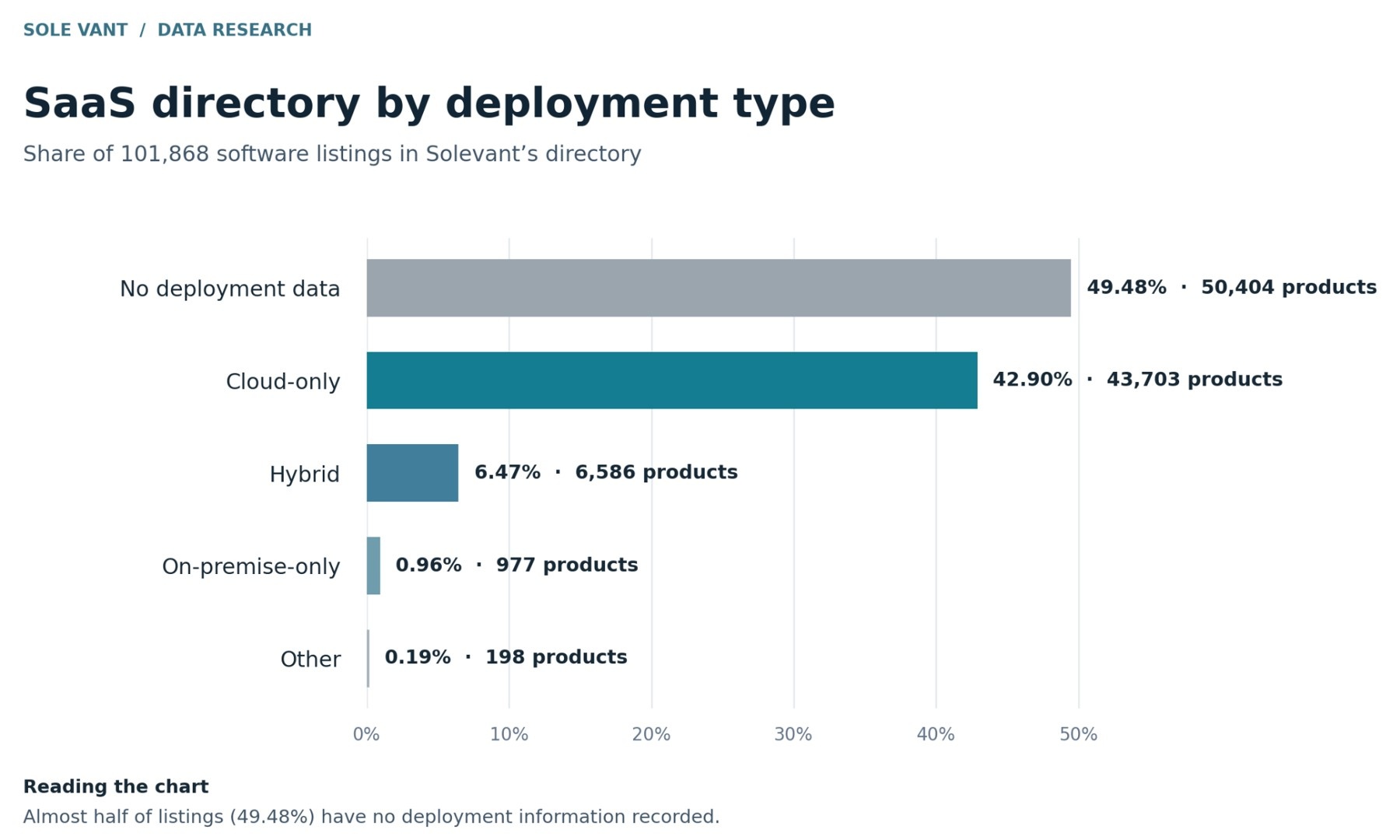
The chart also highlights an important limitation: 50,404 products have no recorded deployment information. Among the 51,464 products with deployment information available, cloud-only products account for approximately 84.9%. Hybrid products make up another 12.8%, while on-premise-only and other deployment types account for the remainder. This provides a clearer picture of deployment patterns among products with recorded data. It also explains why the overall cloud figure of 49.37% should not be interpreted as the actual cloud adoption rate across the entire SaaS industry.
Why Is Hybrid Deployment Important in the Cloud vs On-Premise Comparison?
One of the most notable findings is how frequently cloud and on-premise deployment appear together. Of the 7,563 products supporting on-premise deployment, 6,586 also offer cloud access. That leaves only 977 products without a recorded cloud option. In other words, nearly nine in ten products offering on-premise deployment also provide a cloud alternative.
For software buyers, this distinction matters. An on-premise option does not necessarily mean a product is restricted to installation on company-owned infrastructure. Some vendors provide multiple deployment options within their product portfolios. However, the directory does not establish whether individual customers can switch between them, whether functionality differs, or how deployment preferences influence purchasing decisions.
Which SaaS Categories Have the Highest On-Premise Availability?
On-premise deployment appears more frequently in certain business software categories than others. Inventory Management leads the categories examined, with 20% of its 665 products supporting on-premise deployment. Human Resources follows at 18.3%, while Enterprise Resource Planning (ERP) records 17.7%.
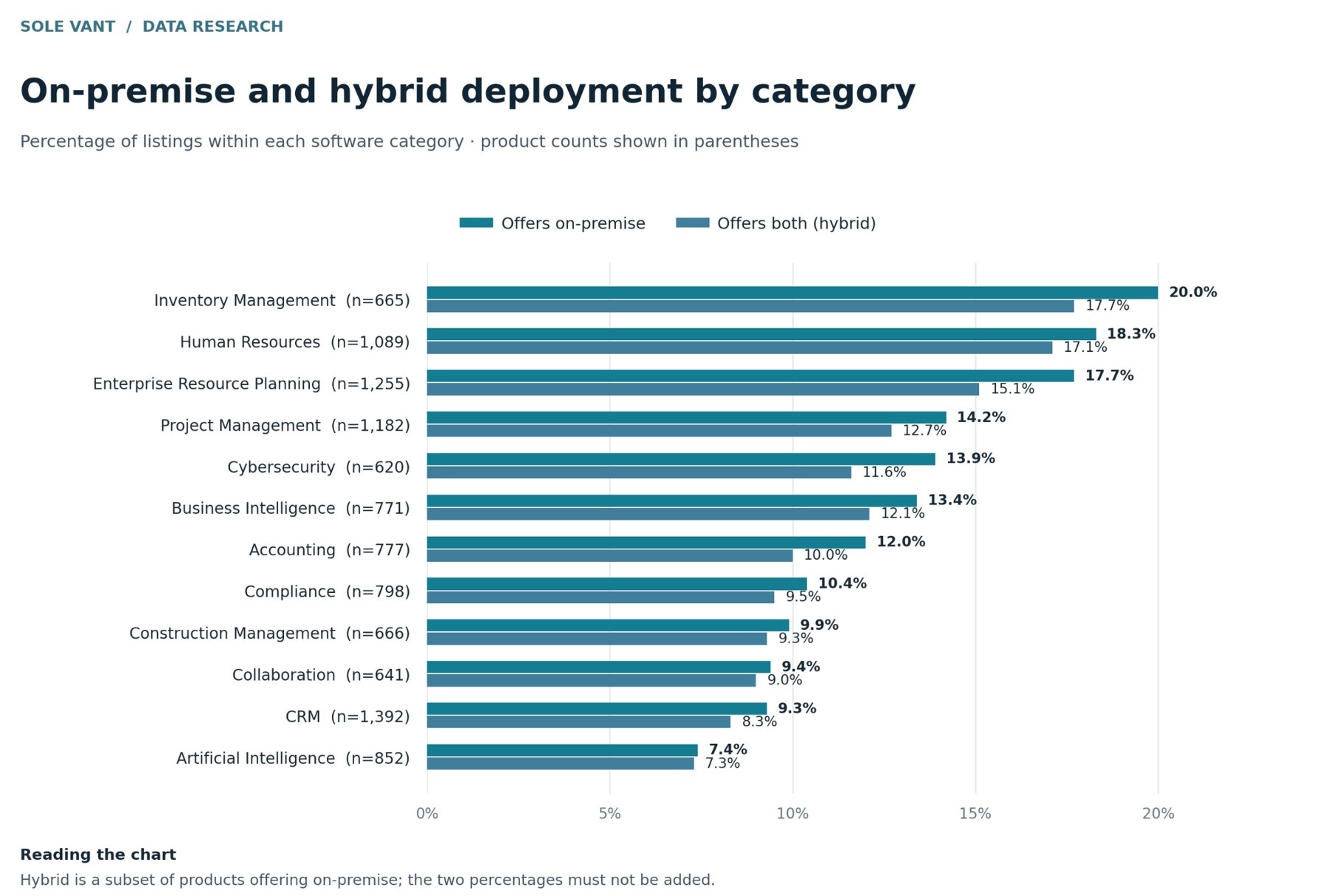
The difference becomes clearer when compared with customer-facing software categories. Only 9.3% of CRM products list on-premise deployment, while Artificial Intelligence software records 7.4%. The same pattern is visible in hybrid deployment. Inventory Management has a 17.7% hybrid share, compared with 8.3% for CRM and 7.3% for Artificial Intelligence software. These figures show that deployment availability varies substantially by software category. They do not, however, establish why particular vendors support on-premise deployment. Factors such as security requirements, customer preferences, or existing infrastructure may influence those decisions, but the source dataset does not measure them.
Which SaaS Vendors Offer the Most Deployment Flexibility?
The report also compares vendors with at least ten products in the directory, revealing considerable differences in their deployment offerings. Hyland Software has the highest hybrid share among the vendors ranked, with 80% of its ten products supporting both cloud and on-premise deployment. Epicor Software and 500apps follow at 50% each. Other vendors place greater emphasis on on-premise availability.
Table: Selected SaaS Vendors by Deployment Availability
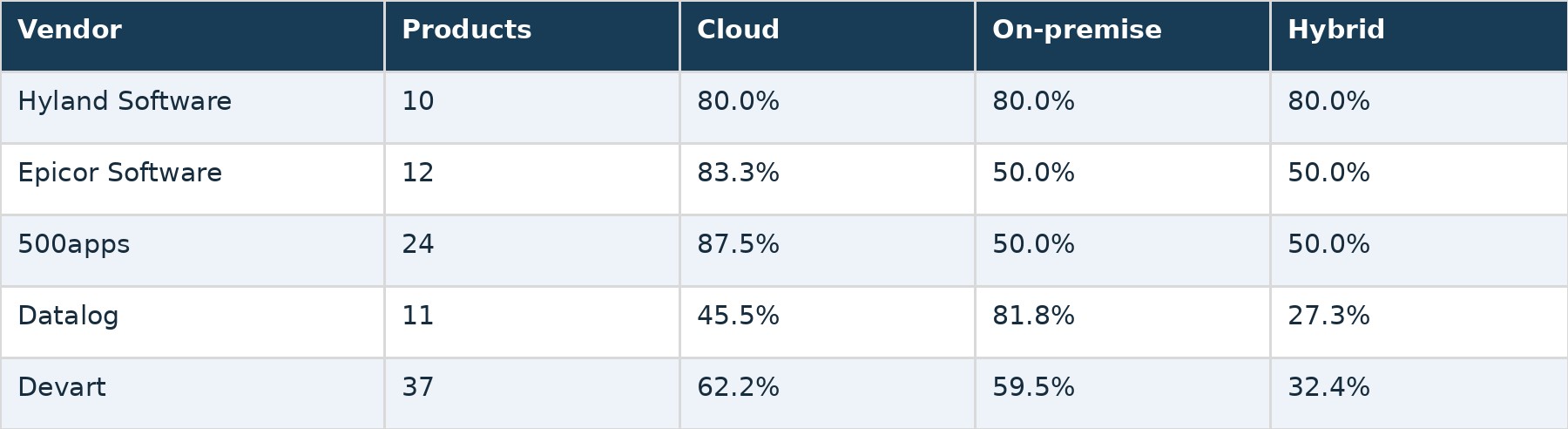
Datalog stands out because its on-premise availability (81.8%) exceeds its cloud availability (45.5%). Devart also has a relatively high on-premise share of 59.5%. These comparisons demonstrate that SaaS vendors do not all follow the same deployment approach. Nevertheless, the vendor samples are relatively small, so the figures should be interpreted as product-level comparisons rather than measures of company-wide market share or customer usage.
Does SaaS Pricing Affect Deployment Availability?
The directory also provides an interesting comparison between deployment options and software pricing. Among products with recorded average monthly prices, cloud availability remains consistently high across every price tier.
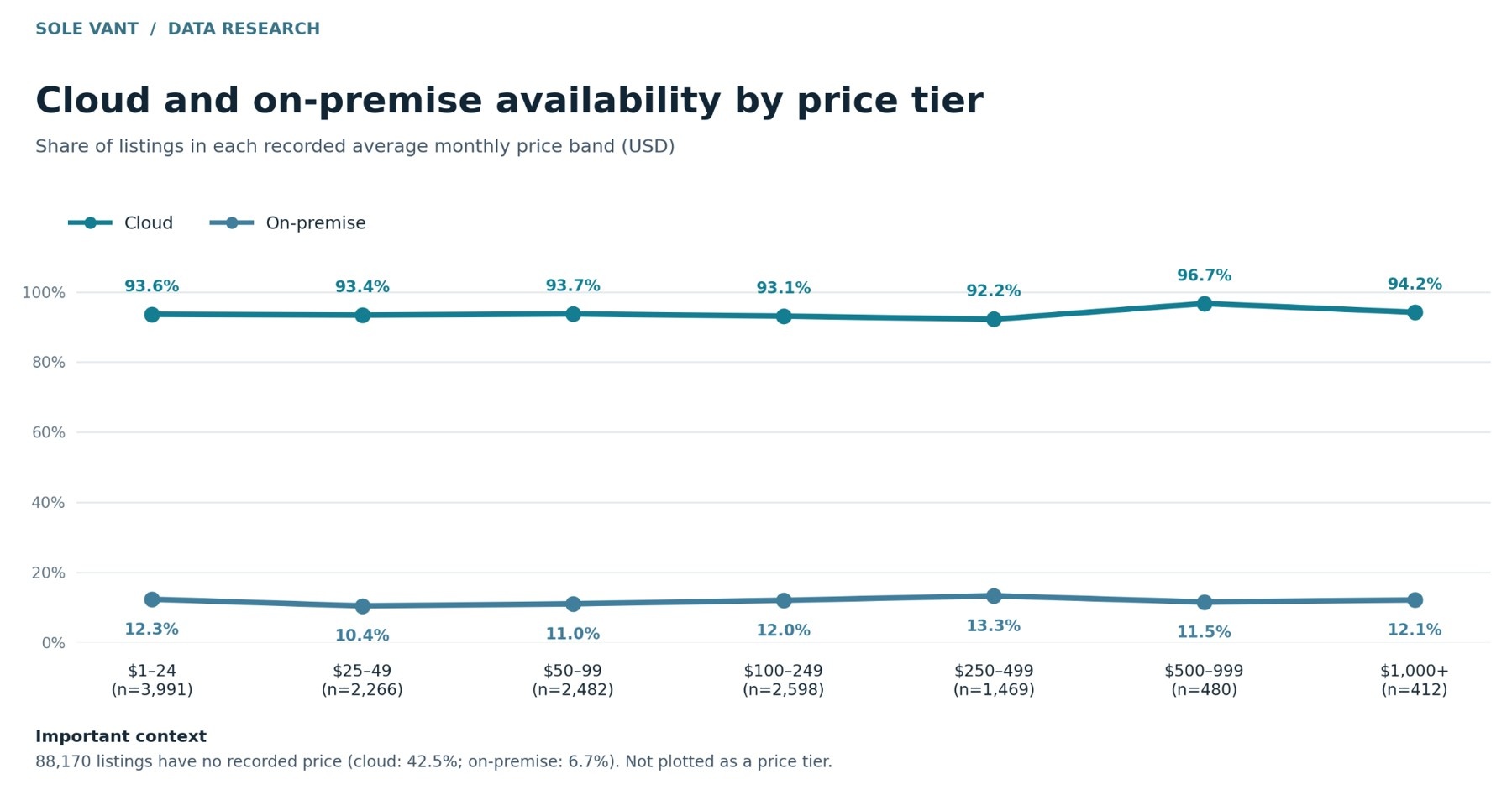
Cloud availability ranges from 92.2% to 96.7% across monthly price tiers beginning at 24 and extending to $1,000 or more. On-premise availability shows considerably less variation than might be expected, ranging from 10.4% to 13.3% across the same tiers. For example, 93.6% of products in the 24 category support cloud deployment, compared with 94.2% in the $1,000+ category.
This suggests that, within the priced subset of the directory, deployment availability does not follow a straightforward pattern of increasing or decreasing with software price. However, 88,170 products have no recorded price. These missing values limit how broadly the findings can be generalized. Company size produces a similarly uneven picture. Cloud availability reaches 92.9% among vendors with 11–50 employees but falls to 29.4% among those with 1,001–5,000 employees. Differences in listing completeness may influence these results.
Methodology and Data Limitations
This analysis uses Solevant's software-directory data, covering 101,868 product listings and their recorded deployment options. Products are classified as cloud-only, hybrid, on-premise-only, other, or lacking deployment information. Individual products may support multiple platforms, so the percentages for deployment options can overlap. Category and pricing comparisons reflect the products within each respective group. Vendor comparisons are limited to companies with at least ten recorded products.
The source does not provide a reporting date or collection period. Furthermore, deployment information is missing for 49.48% of listings, while 88,170 products have no recorded prices. These figures describe deployment options recorded in the directory, not actual customer adoption or a comprehensive measure of the global SaaS market.
Conclusion
Cloud deployment accounts for the majority of Solevant products with recorded deployment information, but the more interesting finding is the relationship between cloud and on-premise availability. Most products offering on-premise deployment also support cloud, while standalone on-premise products represent a relatively small proportion of the directory. Deployment patterns also differ across software categories and vendors, although pricing shows no consistent relationship with deployment availability among products with recorded prices. Taken together, the data provides useful evidence of how SaaS products are listed and offered, while highlighting the importance of complete product information for understanding broader market trends.