
Nigerian SaaS Market: 428 Products Across 381 Vendors
What does Nigeria's SaaS software landscape look like? An analysis of Solevant's Nigerian software catalog identifies 428 products from 381 vendors across 180 software categories. Payment Processing is the largest category, with 43 products. When related categories are grouped together, fintech accounts for 86 products—approximately 20.1% of the catalog.
But the research reveals more than the prominence of financial technology. Most vendors list only one product, recorded integrations are concentrated among a small number of listings, and public pricing information is uncommon. Of the 419 products with recorded software categories, just 10 have a listed price, while 227 require customers to request a quote.
Key Findings
- 428 SaaS products are represented across 381 Nigerian vendors and 180 categories.
- 345 vendors (90.6%) list just one product.
- Payment Processing leads with 43 products, followed by School Management with 15.
- Nine fintech-related categories account for 86 products (20.1%).
- Education technology accounts for 34 products, while healthcare technology accounts for 21.
- 295 vendors (77.4%) have zero recorded integrations, and another 44 have no integration value recorded.
- Paystack has the three highest integration counts among vendor listings: 55, 54 and 53.
- Only 10 of 419 categorized products (2.39%) have a listed price.
- 227 categorized products (54.2%) require a quote.
- FinTech and Digital Banking have 100% quote-required pricing in the recorded category data.
How Large Is Nigeria's SaaS Market?
Solevant's Nigerian dataset contains 428 software products associated with 381 vendors. The products span 180 categories, covering financial services, education, healthcare, business operations, and other software functions. This is a directory-based view of the Nigerian SaaS ecosystem, not an estimate of every SaaS business operating in Nigeria. The research also distinguishes two product totals:
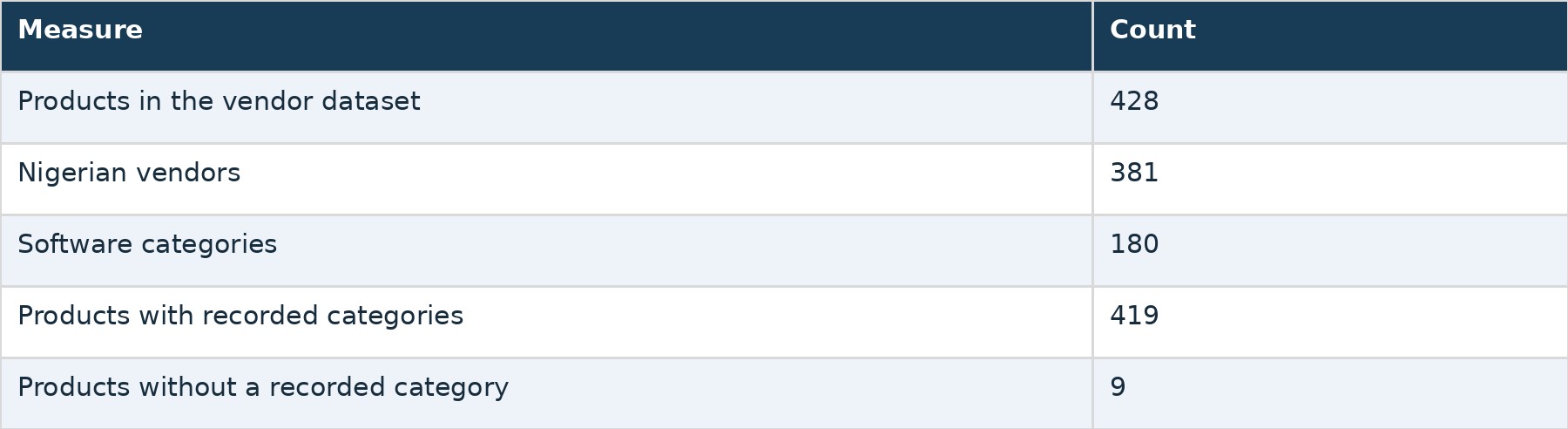
The 428-product total describes the broader Nigerian vendor dataset. Category and pricing analyses use the 419 products with recorded categories. That distinction matters when interpreting percentages, particularly those related to pricing.
Which SaaS Categories Are Most Common in Nigeria?
Payment Processing leads the catalog with 43 products, nearly three times the 15 recorded for School Management. Inventory Management and Learning Management System follow with 13 products each. Enterprise Resource Planning has 11, while Telemedicine has 10.
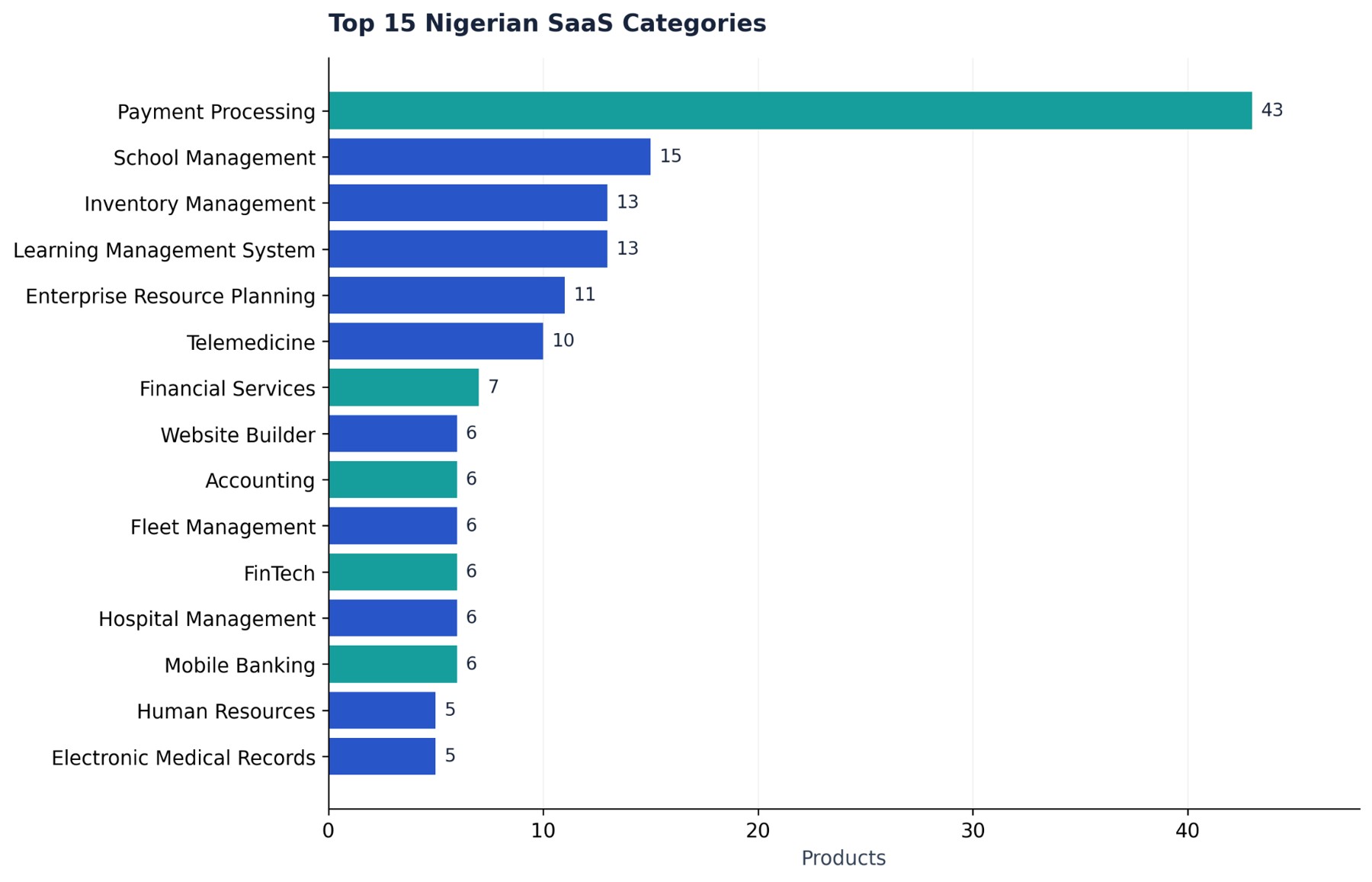
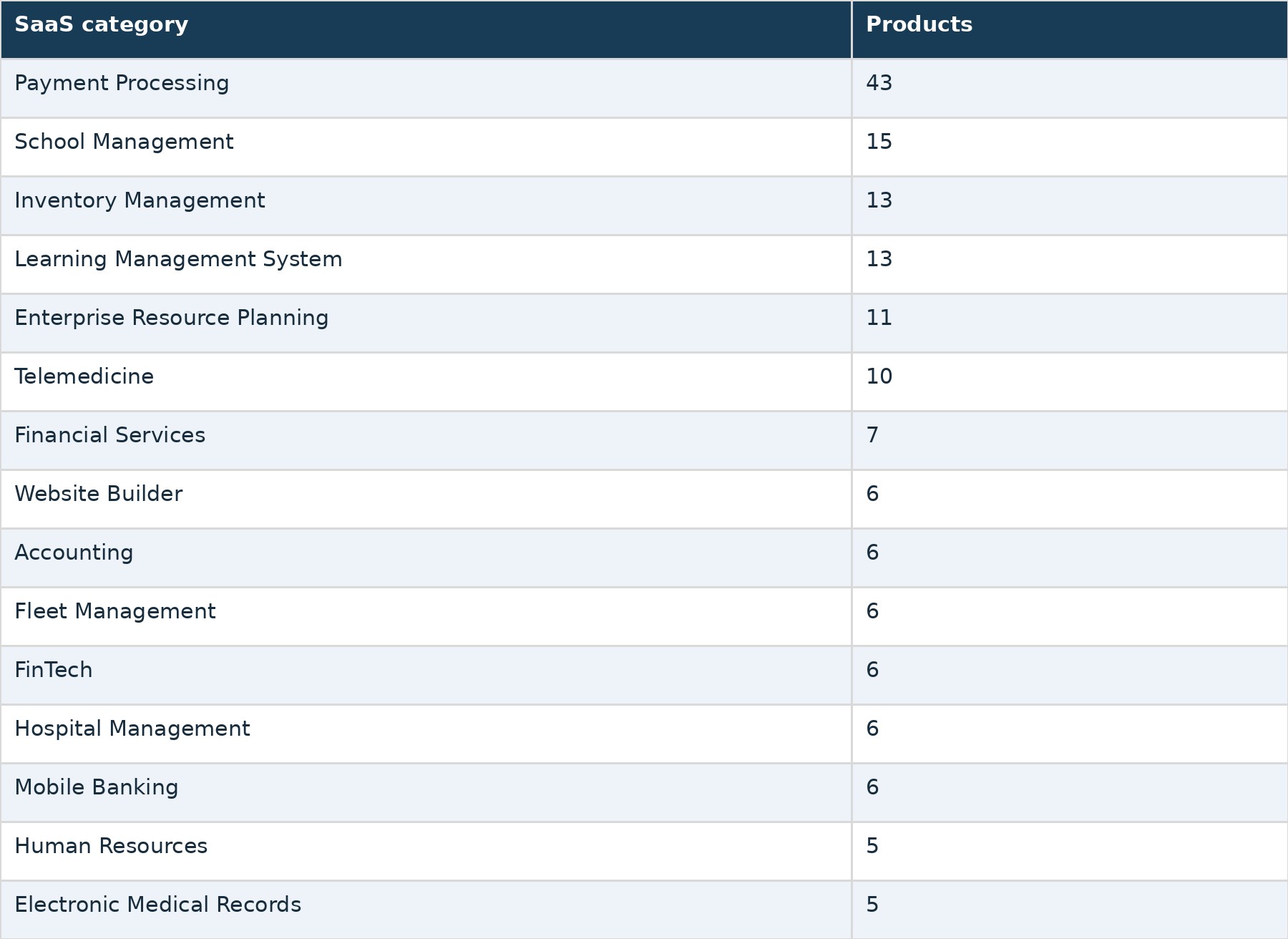
Payment Processing stands out as the only category with more than 15 products. The next largest categories reflect a wider mix of business and institutional software, including school administration, inventory tracking, learning platforms, and healthcare systems. The counts describe products recorded in the catalog. They do not establish which categories generate the most revenue or have the most customers.
Why Does Fintech Stand Out in the Nigerian SaaS Catalog?
Fintech is the largest identifiable industry cluster in the report. Nine categories together account for 86 products, representing 20.1% of the 428-product catalog. The report groups the following categories into its fintech cluster:
- Payment Processing
- Mobile Banking
- FinTech
- Digital Banking
- Financial Services
- Loan Servicing
- Accounting
- Payroll
- Billing and Invoicing
This grouping captures a broader set of financial software products than Payment Processing alone. The next-largest clusters are education technology, with 34 products (7.9%), and healthcare technology, with 21 products (4.9%).
Education and healthcare also have a visible presence
School Management contains 15 products, while Learning Management System has 13. Together, these two categories account for 28 products. In healthcare, Telemedicine has 10 products, Hospital Management has six, and Electronic Medical Records has five. Farm Management also appears in the category analysis with five products. These categories show that Nigeria's recorded SaaS landscape extends beyond financial technology, even though fintech accounts for the largest identified cluster. The dataset does not explain why these categories have attracted vendors or how their commercial performance compares.
How Concentrated Is Nigeria's SaaS Vendor Landscape?
Most Nigerian vendors represented in the catalog list only one product. Of 381 vendors, 345 (90.6%) have a single product. Another 28 vendors list two products, while only eight list three or more.
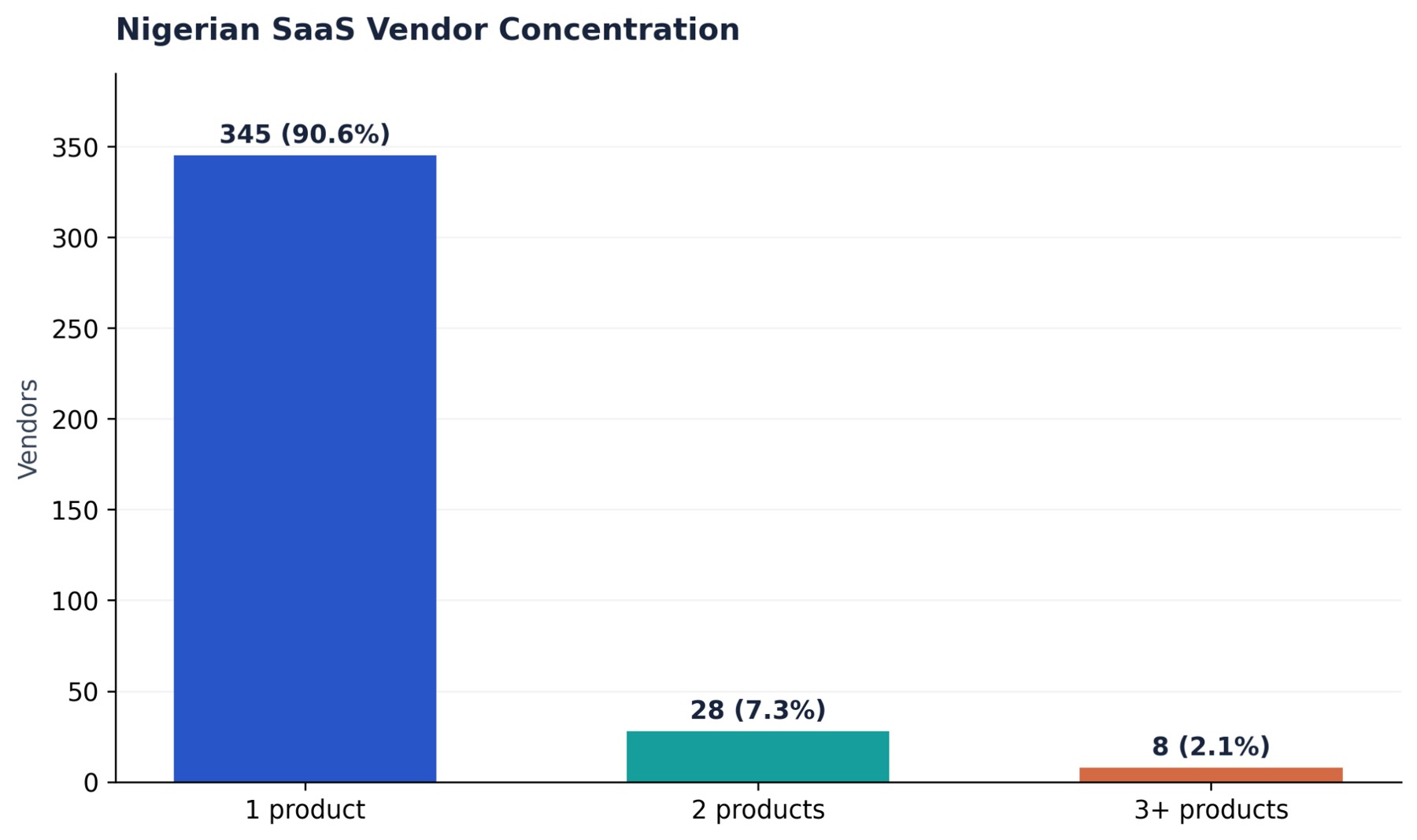
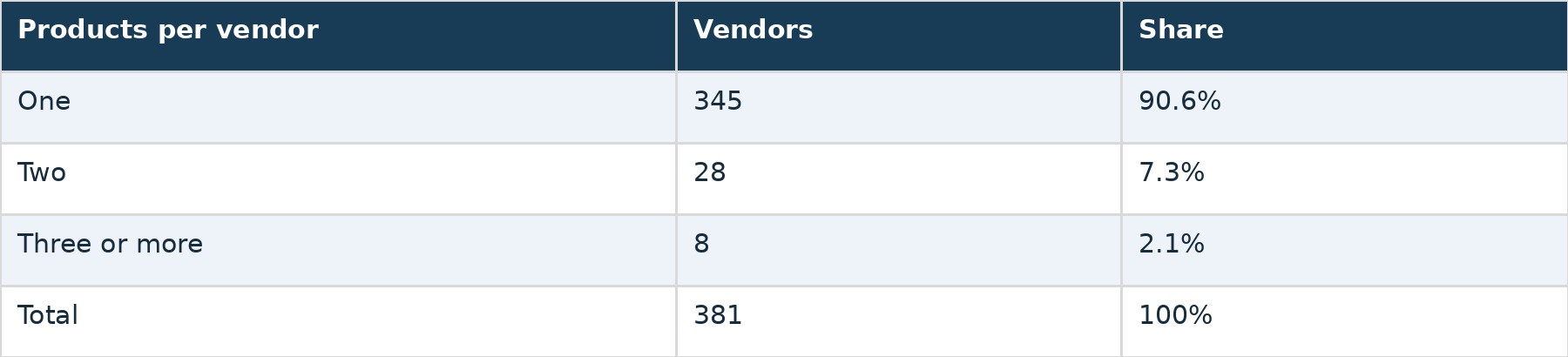
Global Accelerex has the largest recorded product portfolio, with five products. Upperlink Limited follows with four. Six vendors have three products each: Klump, Luzoma Microsystems, Xend Finance, Helium Health, Union Systems Limited, and Nomba. The average is approximately 1.1 products per vendor. This distribution indicates that the catalog is dominated by vendors with small recorded product portfolios. However, a vendor with one listed product is not necessarily a small business. Product count does not reveal employee numbers, revenue, customer base, or company maturity.
How Common Are Software Integrations Among Nigerian SaaS Vendors?
Integrations allow software products to connect with external applications, services, or platforms. The Nigerian dataset contains integration counts associated with vendor records, but coverage is uneven. Of the 381 vendors:
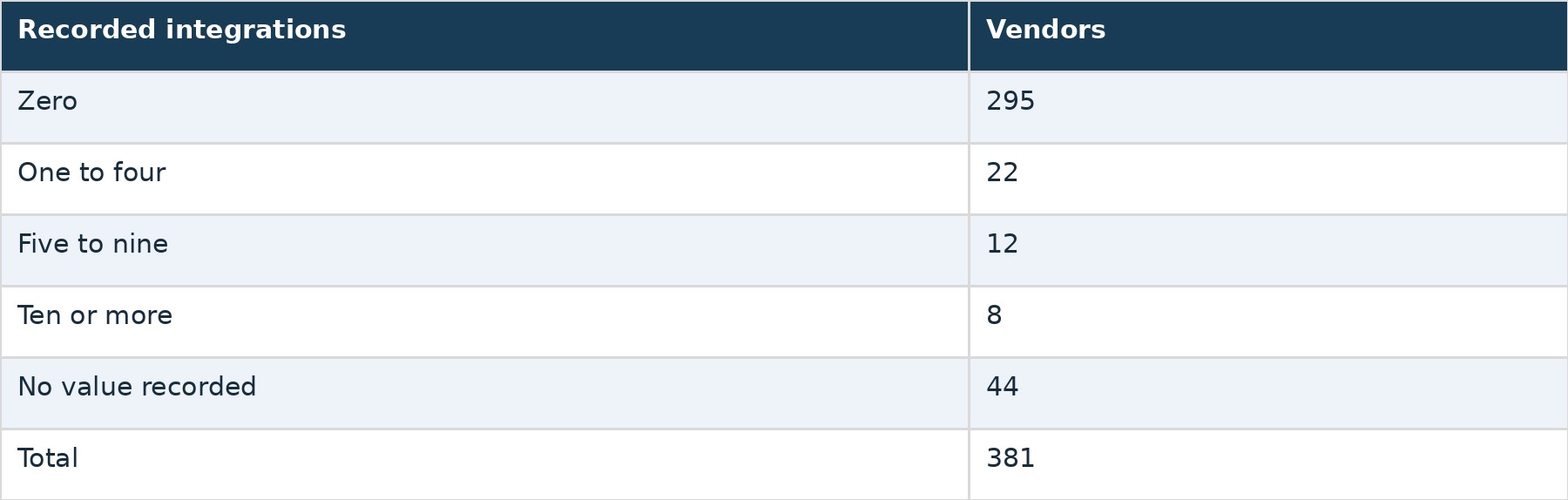
A total of 295 vendors (77.4%) have zero recorded integrations. Another 44 have no integration value recorded. Only 42 vendors have one or more recorded integrations. The distinction between zero and missing values is important. The dataset cannot establish whether a zero reflects a product with no integrations or an incomplete directory record.
Which Nigerian SaaS vendor listings have the most integrations?
Paystack has the three highest recorded integration counts: 55, 54, and 53. These are three separate listings associated with Paystack, not three different vendors. The next-highest listing is Zoho, with 27 integrations. Other listings include Netapps Technologies, Netapps Technologies Ltd, and another Zoho record at 17 integrations each. The results show a pronounced concentration of recorded integrations among a small number of listings. They do not measure integration quality, usage, reliability, or how much revenue those integrations generate.
How Transparent Is SaaS Pricing in Nigeria?
Published pricing is uncommon in the Nigerian catalog. Among the 419 categorized products, only 10 have a recorded listed price. By contrast, 227 require a quote.
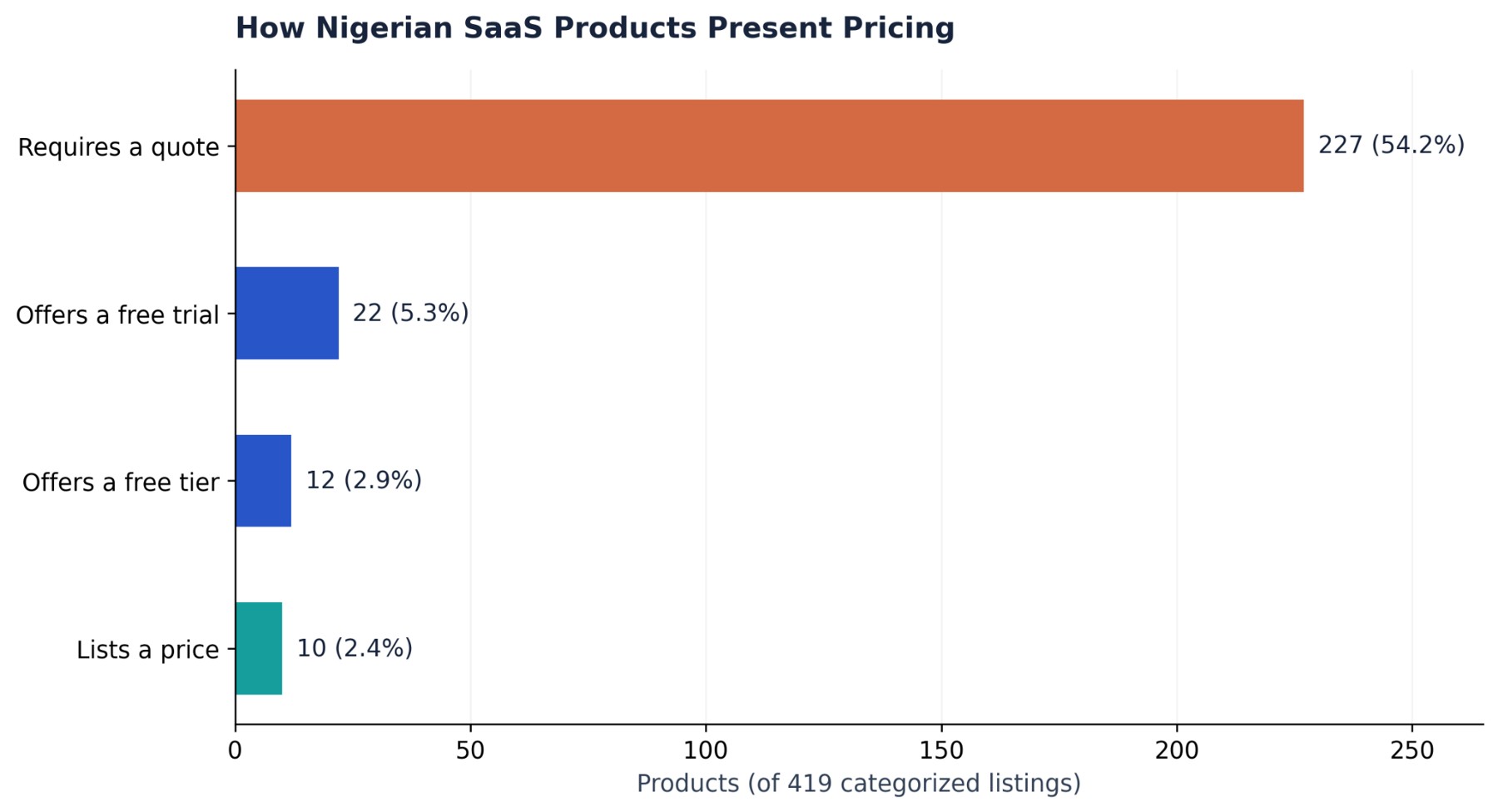
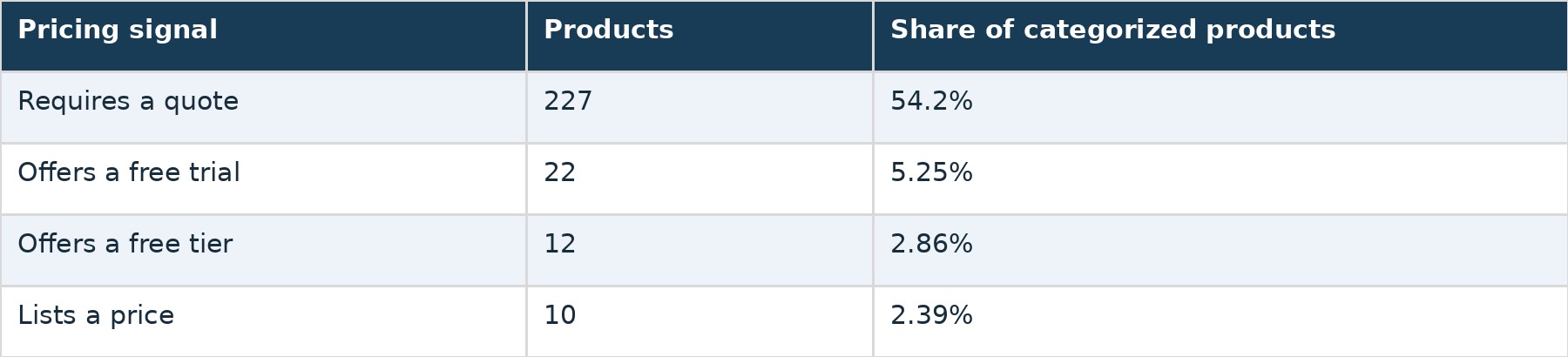
These signals are not mutually exclusive. A product may, for example, offer a free trial while also requiring a quote for its paid plans. The percentages therefore should not be added together to produce a single pricing distribution. The data shows that publicly recorded prices are rare within this catalog. It does not establish whether the same vendors publish prices elsewhere or provide them through other sales channels.
What is the difference between a free trial and a free tier?
A free trial generally provides temporary access to a product before payment is required. A free tier is an ongoing free plan, often with limits on features, users, or usage. In the Nigerian dataset, 22 products have a recorded free-trial offering, while 12 have a recorded free tier. These counts are much smaller than the number of products requiring a quote.
Which Nigerian SaaS Categories Require Customers to Request a Quote?
Quote-required pricing is not equally common across software categories. FinTech and Digital Banking both have 100% quote-required pricing in the report's category analysis. Mobile Banking follows at 83.3%, while Compliance records 80%. Financial Services has a quote-required share of 71.4%.
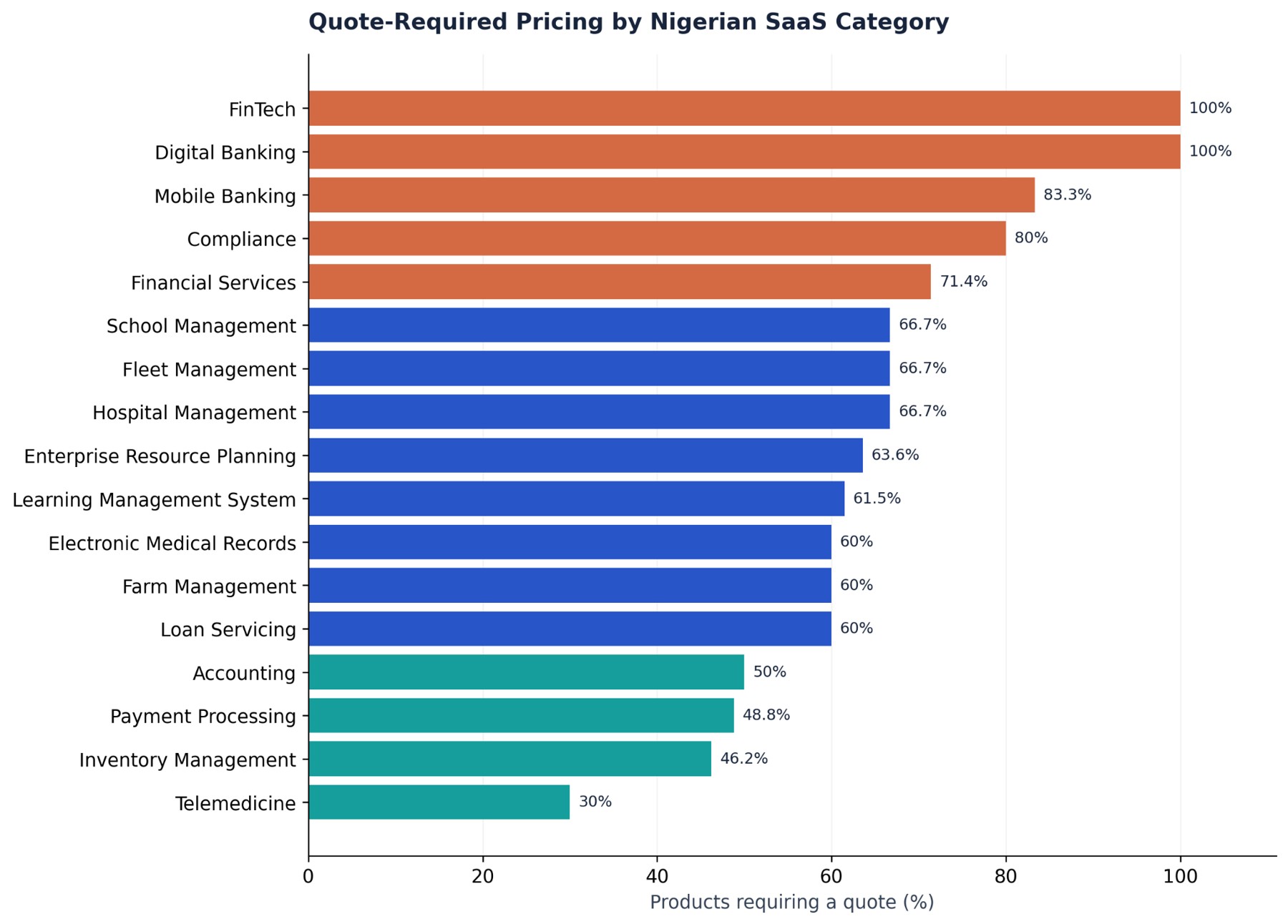
Selected categories show the following differences:
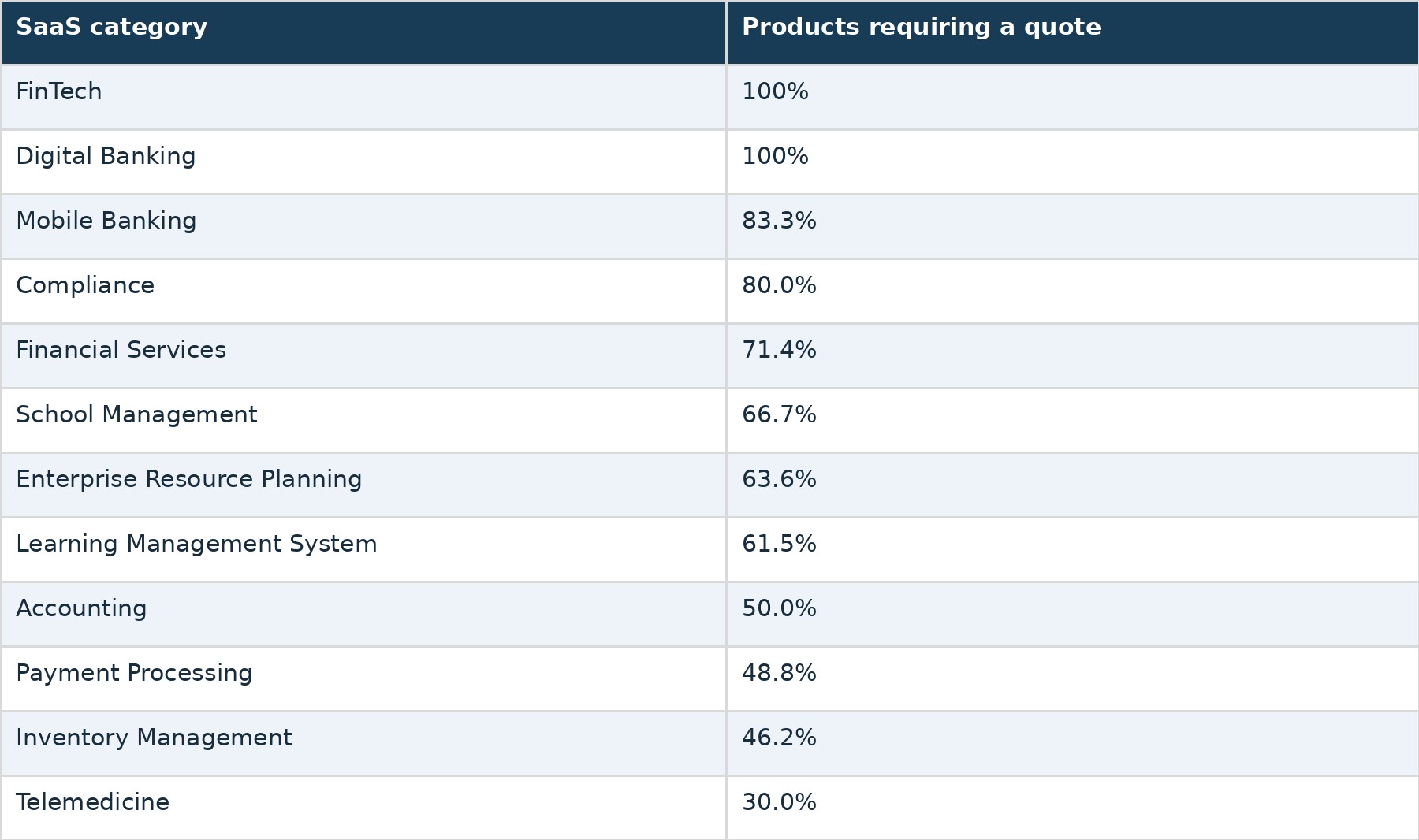
The report's chart includes categories with at least five products. Telemedicine has the lowest quote-required share among the categories highlighted in that comparison, at 30%. Inventory Management and Payment Processing also fall below 50%. Interestingly, the broad FinTech category records 100% quote-required pricing, while Payment Processing—the largest individual category—records 48.8%. This illustrates why related financial software categories should not automatically be treated as having identical pricing practices. The dataset records pricing signals but does not explain why vendors choose quote-based pricing.
What Does the Research Reveal About Nigeria's SaaS Ecosystem?
Three patterns stand out. First, fintech is prominent but not the whole story. The financial software cluster represents approximately one in five recorded products, while education, healthcare, and operational software also have meaningful representation. Second, vendor portfolios are highly concentrated at one product. More than 90% of vendors list a single product, although that does not indicate company size or commercial success.
Third, pricing information is limited. Just 2.39% of categorized products have a recorded listed price, while more than half require a quote. The integration data adds another qualification: most vendors have no recorded integrations, but missing information prevents firm conclusions about how connected their products actually are. For software buyers, these findings highlight the value of checking product pricing, integrations, and capabilities directly. For founders, researchers, and investors, the catalog provides a useful map of recorded Nigerian software categories—but not a complete picture of market demand, revenue, or growth.
Methodology and Data Limitations
This analysis is based on Solevant's Nigerian SaaS dataset, derived from a software-directory extract filtered to vendors with Nigeria recorded as their country. The workbook contains vendor, category, and pricing information. The vendor data covers 381 vendors and 428 products. Category and pricing analysis covers 419 categorized products across 180 categories. Category totals are aggregated across repeated category records in the source data.
The research examines product counts, vendor portfolios, recorded integration counts, and four pricing signals: listed price, free trial, free tier, and quote-required. Several limitations apply: The dataset is a single-directory sample, not a census of all Nigerian SaaS companies. The source does not provide a reporting period or update frequency. Nine products lack recorded category information. Pricing signals can overlap.
Many integration records contain zero or missing values, which may not accurately represent actual product capabilities. Some vendors, including Paystack, appear in multiple source listings. Product counts do not measure revenue, customer adoption, profitability, or company size. The data does not establish why vendors choose particular pricing models. The findings should therefore be interpreted as a description of the Nigerian SaaS products represented in Solevant's catalog.
Frequently Asked Questions
How many SaaS products are in Nigeria?
Solevant's Nigerian directory sample contains 428 products from 381 vendors. This is not a count of every SaaS product operating in Nigeria.
Which SaaS category is largest in Nigeria?
Payment Processing leads the dataset with 43 products, followed by School Management with 15.
How important is fintech in Nigeria's SaaS landscape?
Nine fintech-related categories account for 86 products, equivalent to 20.1% of the catalog.
How many Nigerian SaaS vendors offer multiple products?
Thirty-six vendors list at least two products. Of these, eight have three or more.
Which vendor has the most recorded integrations?
Paystack has the highest integration counts, appearing in three separate listings with 55, 54, and 53 integrations.
Do Nigerian SaaS products publish their prices?
Only 10 of 419 categorized products have a recorded listed price, while 227 require a quote.
Which SaaS categories rely most on quote-based pricing?
FinTech and Digital Banking have 100% quote-required pricing in the dataset, followed by Mobile Banking at 83.3%.
Does the dataset represent the entire Nigerian SaaS market?
No. It represents products and vendors included in Solevant's directory and should be treated as a sample.
Conclusion
Solevant's Nigerian SaaS dataset reveals a diverse software landscape represented by 428 products across 381 vendors. Payment Processing leads the individual categories, while fintech collectively accounts for approximately 20% of recorded products. Most vendors list only one product, integrations are unevenly documented, and public pricing information is limited. The findings provide a useful directory-based view of Nigerian SaaS, particularly for understanding category representation and pricing practices. They also highlight an important research challenge: incomplete pricing and integration information makes it difficult to compare software products without additional vendor-level verification.