
SaaS Industry Specialization Across 263 Software Categories
How specialized is the SaaS market? Some software categories are designed for a specific type of business, while others claim to serve customers across multiple industries. Solevant's industry-specialization research examines 263 software categories and 85 declared industries, revealing a striking pattern: nearly three-quarters of categories identify exactly four industries, and most of those categories name the same four. Healthcare, Education, Retail, and Finance dominate the dataset. Together, they account for 91.62% of all 44,641 product-industry mentions.
But these figures require careful interpretation. The data records which industries software categories declare they serve. It does not measure customer adoption, industry revenue, or the number of unique SaaS products operating in each sector.
Key findings
- 263 software categories are represented across 85 industry labels.
- 196 categories (74.5%) declare exactly four industries.
- 193 categories identify the same combination: Healthcare, Education, Retail, and Finance.
- The four leading industries account for 40,900 of 44,641 mentions (91.62%).
- 27 categories declare only one industry.
- Lead Generation and Point of Sale have the broadest declared coverage, at seven industries each.
- CRM is the largest category in the report, with 277 products and five declared industries.
- Healthcare appears in 216 of the 263 categories, making it the most frequently declared industry.
What does SaaS industry specialization mean?
In this report, industry specialization describes the number and identity of industries associated with a software category in Solevant's catalog. For example, a CRM category may list Healthcare, Education, Retail, Finance, and Manufacturing as industries it serves. A Veterinary software category, by contrast, may declare only Veterinary. This distinction allows us to examine two different characteristics: Industry breadth: How many distinct industries a software category declares. Industry concentration: How frequently particular industry labels appear across the category data. Neither measure establishes that customers in those industries actively use the products. They describe the catalog's industry classifications.
Four industries account for 91.62% of mentions
The most prominent result is the concentration of product-industry mentions within four labels.
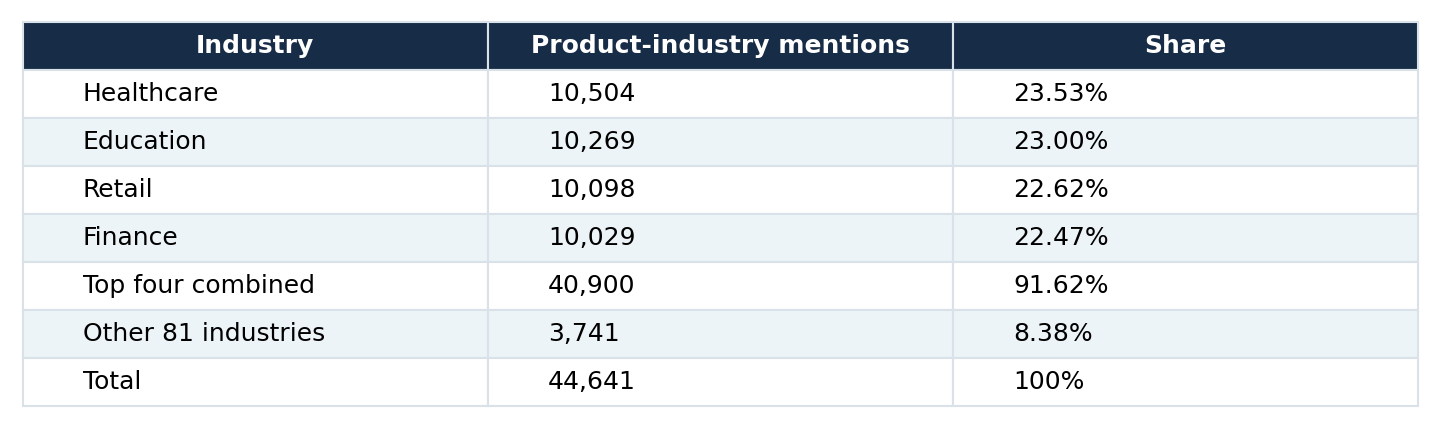
Healthcare leads, although the four industries are relatively close in their individual shares. The difference between Healthcare and Finance is just 1.06 percentage points. The remaining 81 industries collectively account for less than one-tenth of recorded mentions.
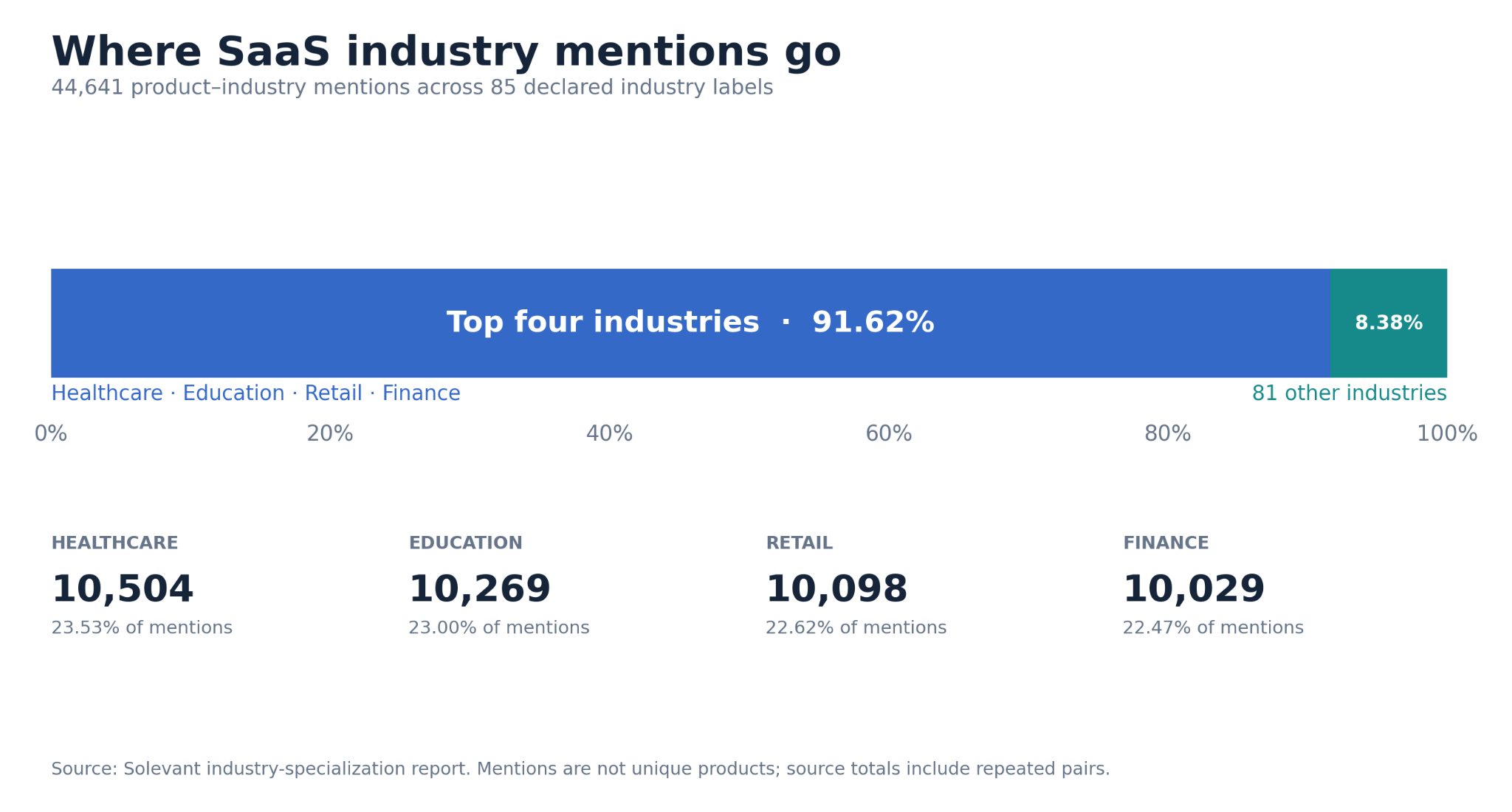
Healthcare, Education, Retail, and Finance account for 91.62% of recorded product-industry mentions. These are repeated category-level mentions, not unique product counts.
Why the concentration matters
The result suggests that broad industry classifications are extremely common in the catalog. However, the report also shows that 193 categories use exactly the same four-industry combination. That consistency is an important data-quality consideration: it may limit how effectively these labels distinguish one category's intended audience from another. The source does not explain why these categories share the same classification, so the pattern should not be interpreted as evidence of a particular tagging practice.
How many industries does a typical SaaS category declare?
The distribution is heavily concentrated around four industries.
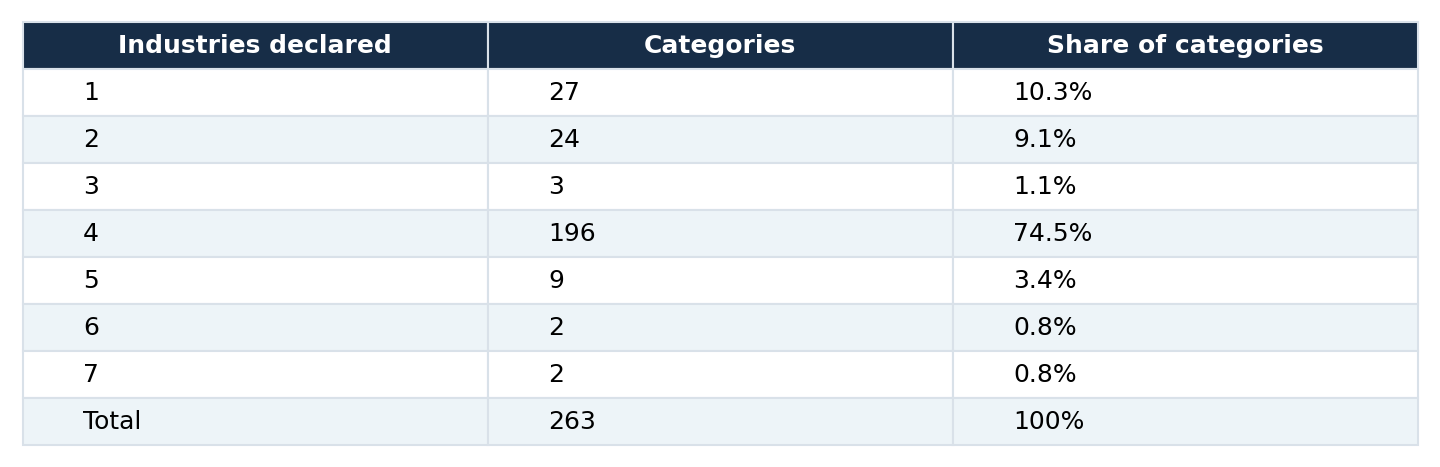
The four-industry group contains 196 categories. No other breadth group contains more than 27. Only 13 categories declare five or more industries, while 27 declare a single industry.
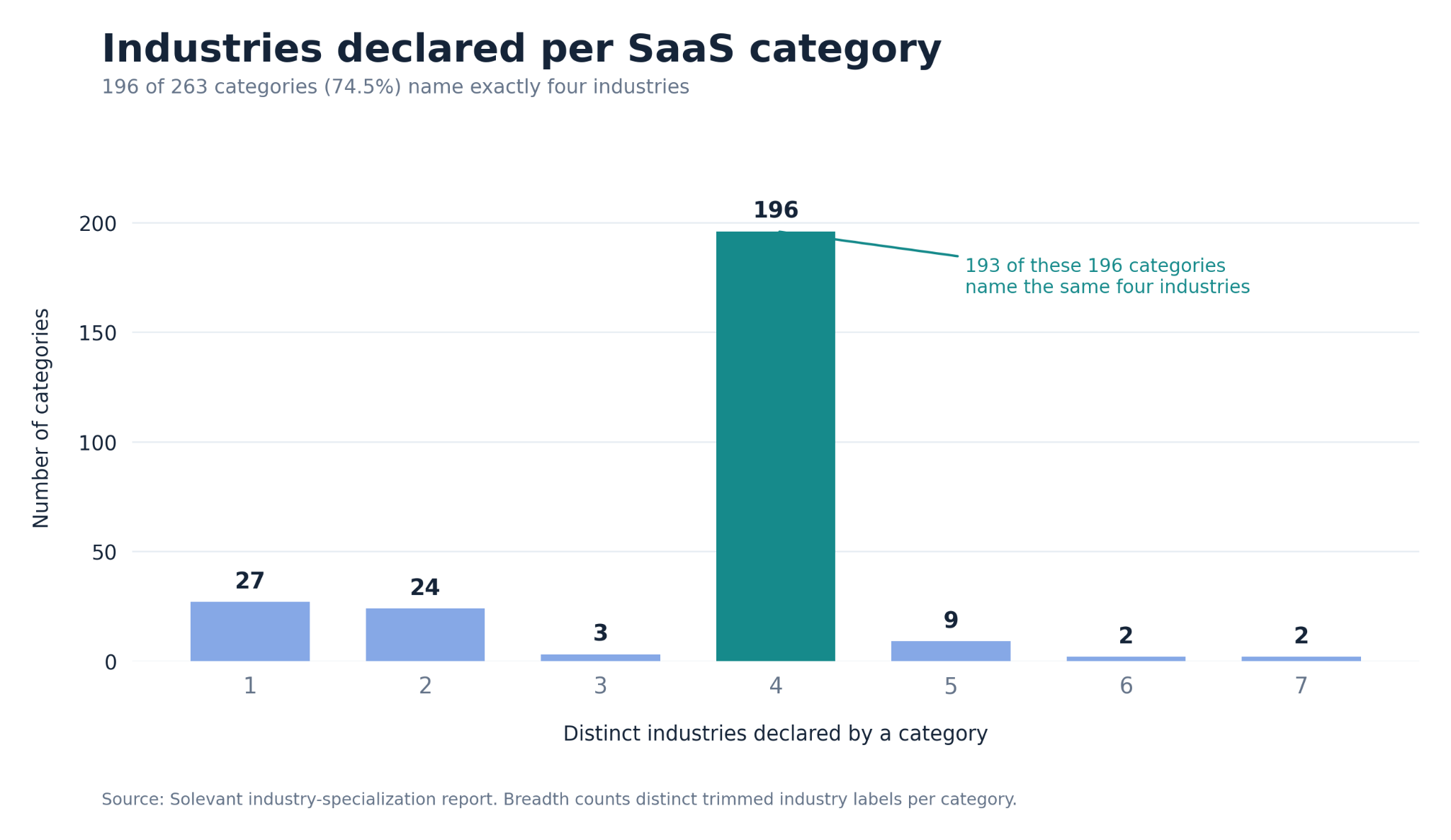
Nearly three-quarters of software categories declare exactly four industries. Only two categories declare seven. The pattern indicates that four-industry classification is the dominant structure in this dataset, rather than industry breadth being distributed evenly across categories.
Which industries appear beyond the leading four?
The distribution changes dramatically after Finance, the fourth-ranked industry. Real Estate ranks fifth with 421 mentions, followed by Property Management with 345. Hospitality, in seventh place, has 189.
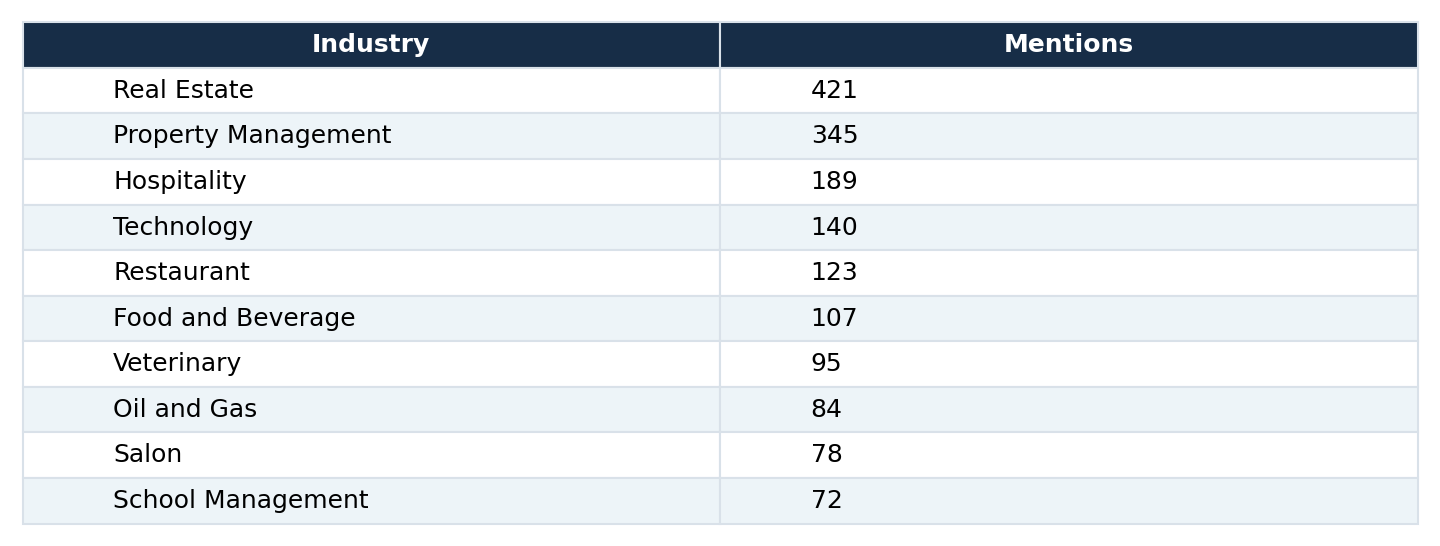
For comparison, Finance alone has 10,029 mentions. The large gap is also visible when counting how many categories declare each industry. Healthcare appears in 216 categories, Retail in 207, Education in 206, and Finance in 204. The next industry, Real Estate, appears in only seven categories.
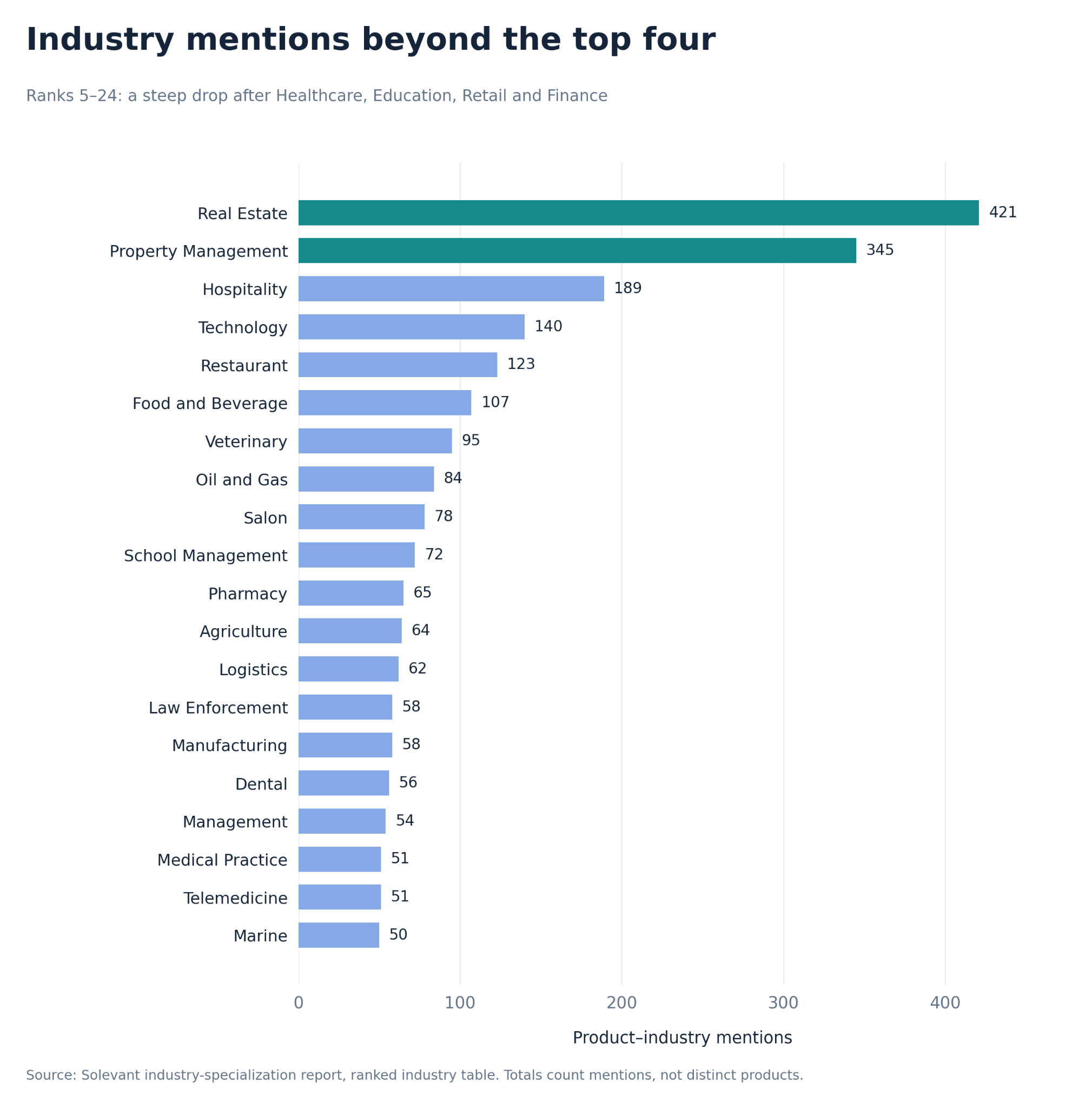
Outside the four dominant industries, Real Estate and Property Management lead a much smaller group of industry labels.
The long tail of industry labels
The report identifies 71 industries that appear in only one software category. Examples include Winery, Funeral Home, Optometry, and Aviation. This creates a distinction between widely reused industry labels and highly specific labels associated with particular types of software. A smaller mention count does not necessarily mean that an industry has little demand for SaaS. It means that the industry label appears less frequently in this catalog extract.
Does a category serving more industries contain more products?
A category's declared industry breadth does not reliably indicate how many products it contains.
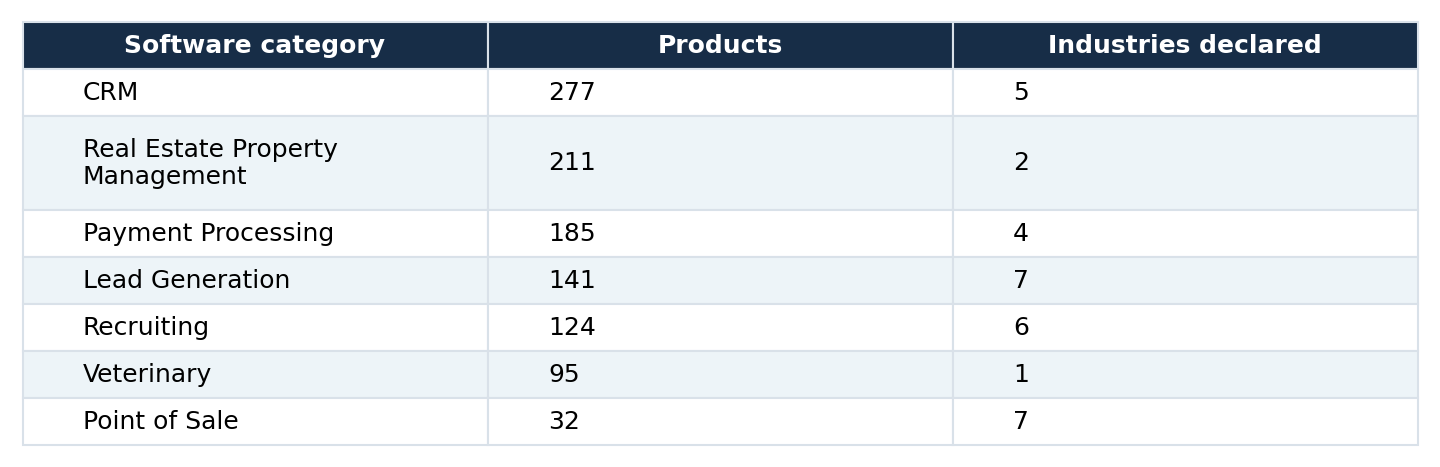
CRM is the largest category, with 277 products, but it does not have the widest industry coverage. Real Estate Property Management has 211 products and declares just two industries: Real Estate and Property Management. Point of Sale declares seven industries, yet has only 32 products in the category. Across all 263 categories, the median category size is 32 products, while the mean is approximately 45.3 products.
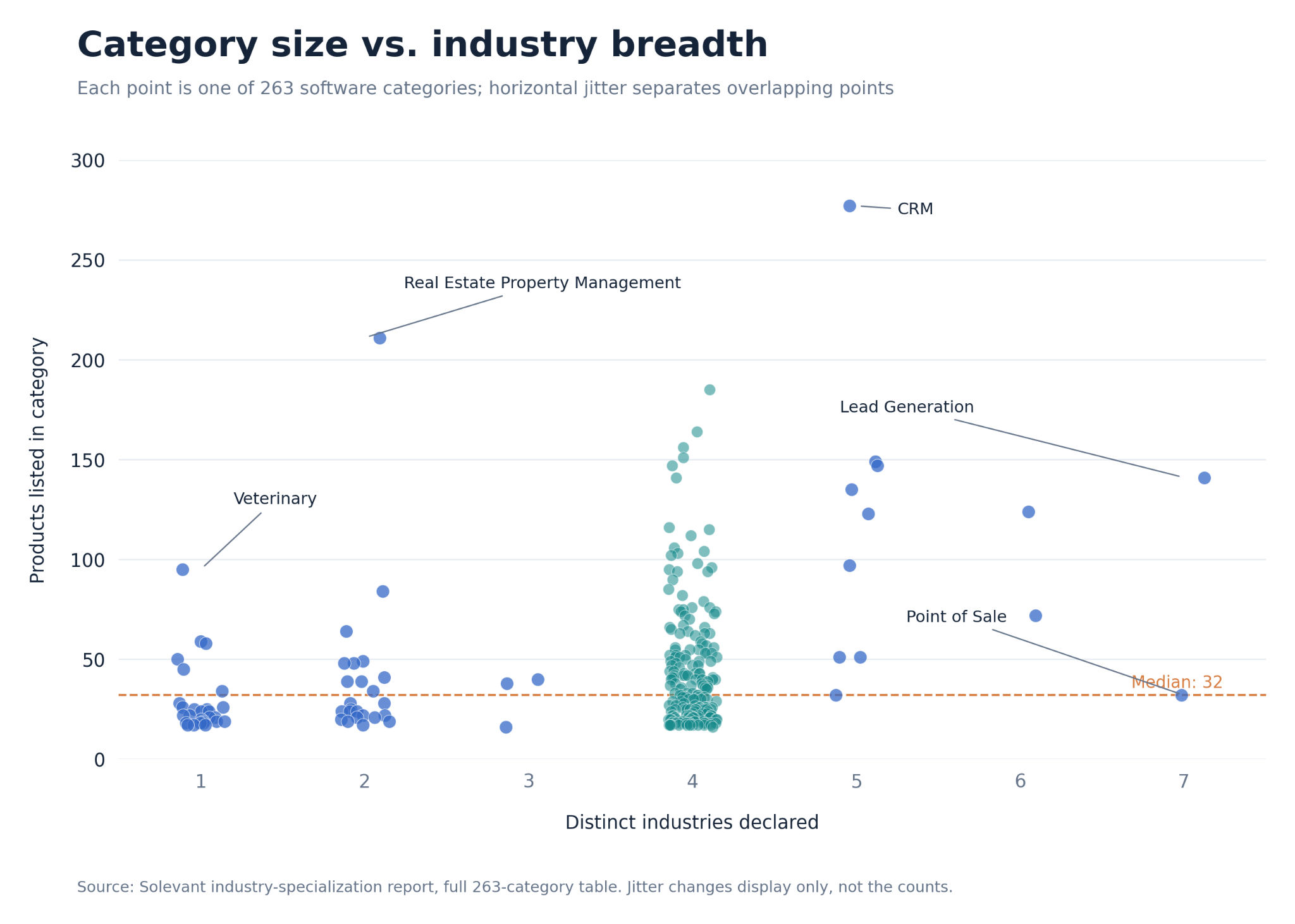
Category size varies considerably even among categories declaring the same number of industries. Each point represents one software category.
The chart demonstrates why category breadth and category size should be evaluated separately. A category can be large while narrowly classified, or relatively small while declaring broad industry coverage.
The 27 single-industry SaaS categories
Not every software category follows the broad four-industry pattern. The dataset contains 27 categories that declare exactly one industry. Their category-level product counts sum to 787, with a median of 22 products per category.
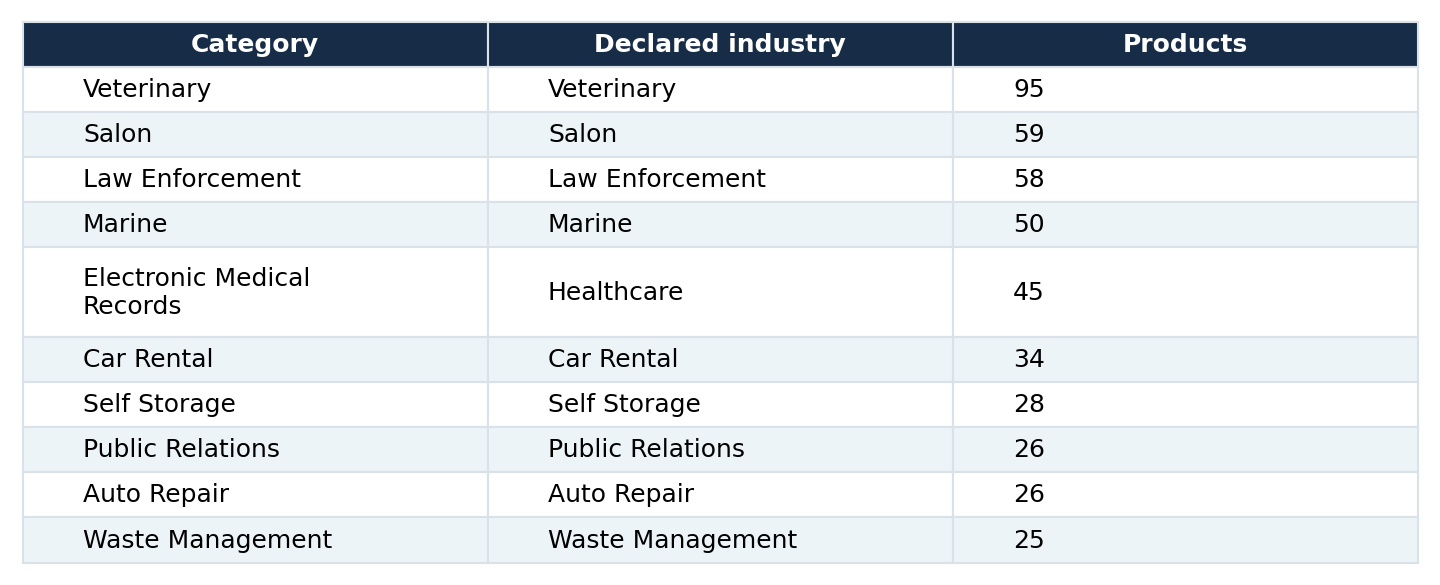
In 25 of the 27 categories, the declared industry has the same name as the software category. The two exceptions are Electronic Medical Records, which declares Healthcare, and Real Estate Transaction Management, which declares Real Estate. These categories provide examples of software classifications aimed at a clearly defined industry. They also show that a narrow industry declaration does not necessarily imply a tiny category.
Which SaaS categories declare the most industries?
Only two categories reach the maximum breadth of seven industries.
Lead Generation
Lead Generation contains 141 products and declares: Education, Finance, Healthcare, Marketing, Real Estate, Retail, and Technology.
Point of Sale
Point of Sale contains 32 products and declares: Education, Entertainment, Finance, Food and Beverage, Healthcare, Hospitality, and Retail. Two additional categories declare six industries: Recruiting: 124 products. School Management: 72 products. Nine categories declare five industries, including CRM, Website Builder, Marketing Automation, Collaboration, Enterprise Resource Planning, and Live Chat. These classifications illustrate how software categories can combine general-purpose business functions with more specialized industry applications.
What the findings mean for SaaS buyers and vendors
For SaaS buyers, the report highlights the importance of looking beyond an industry label when evaluating software. A category associated with Healthcare or Finance is not necessarily designed exclusively for those sectors. Buyers should still assess product features, workflows, compliance requirements, integrations, and customer use cases. For SaaS vendors, the findings suggest that industry descriptions may need more detail to communicate a meaningful specialization. For example, identifying a product as suitable for Healthcare is less informative than explaining whether it supports clinical records, appointment management, billing, or another healthcare-specific workflow. For researchers, the dataset demonstrates why industry counts should be separated from measures of product adoption, customer activity, and market size.
Methodology and data limitations
This analysis uses Solevant's SaaS Industry Specialization research report and its catalog extract. The report covers 1,000 category-industry rows, 263 categories, and 85 distinct industry labels after trimming surrounding whitespace.
Mentions are not unique SaaS products
The product count for a software category repeats across its industry rows. Adding those counts produces product-industry mentions, not a count of distinct products.
Duplicate category-industry pairs affect the totals
The report identifies 61 repeated category-industry pairs, adding 1,429 mentions to the total. The published mention total is 44,641. Removing those repeated pairs would reduce it to 43,212. The charts retain the report's published mention totals so that their figures remain consistent with the source.
Industry labels contain inconsistencies
Trimming whitespace reduces the source's 102 raw industry strings to 85 labels. The report also identifies an unresolved punctuation variation between “Oil and Gas” and “Oil and Gas.”
One category is unnamed
One of the 263 categories has no recorded name and contains 31 products. It remains included in the analysis.
No reporting period was supplied
The source does not specify a collection date, reporting window, update frequency, or dataset inclusion rules. Consequently, these figures should not be presented as a current-year market census, a historical trend, or a measure of the entire global SaaS market.
Frequently asked questions
How many software categories were analyzed?
The report covers 263 software categories associated with 85 distinct industry labels.
Which industries appear most frequently?
Healthcare, Education, Retail, and Finance dominate, accounting for 40,900 of the 44,641 recorded product-industry mentions.
How many industries does the typical category declare?
Four. A total of 196 categories, or 74.5%, declare exactly four industries.
Which SaaS categories declare the most industries?
Lead Generation and Point of Sale lead with seven industries each.
Which categories are the most specialized?
Twenty-seven categories declare exactly one industry. Veterinary, Salon, Law Enforcement, and Marine are the largest examples by category product count.
What is the largest software category?
CRM, with 277 products. It declares five industries.
Does a higher industry count mean a larger software category?
Not necessarily. Real Estate Property Management has 211 products across two industries, while Point of Sale has 32 products across seven.
Does this research measure SaaS market share?
No. It analyzes category classifications and product-industry mentions, not revenue, customer numbers, installations, or market share.
Conclusion
Solevant's industry-specialization data reveals two distinct patterns. First, most software categories share a remarkably similar industry classification. Nearly three-quarters declare four industries, and 193 categories identify exactly the same combination of Healthcare, Education, Retail, and Finance. Second, a smaller group of categories is much more narrowly classified, with 27 declaring a single industry. Together, these findings show how broad and specialized industry labels coexist in the SaaS catalog. They also demonstrate why declared industry coverage should be treated as a starting point for understanding software positioning—not as proof of adoption or market demand.