
Details
Category
Author
Role
Author / Writer
Industry
Arts & Literature
Wikidata
Q997
Notable for
Andrei Dmitrievich Sakharov was born in , the son of a physics teacher. In 1938, he entered Moscow State University. When the university w
Birth Date
1921-05-21
Death Date
1989-12-14
Gender
male
Nationality
Soviet Union
Birthplace
Moscow
Occupations
physicist, human rights defender, nuclear physicist, politician
Education
MSU Faculty of Physics
Bio
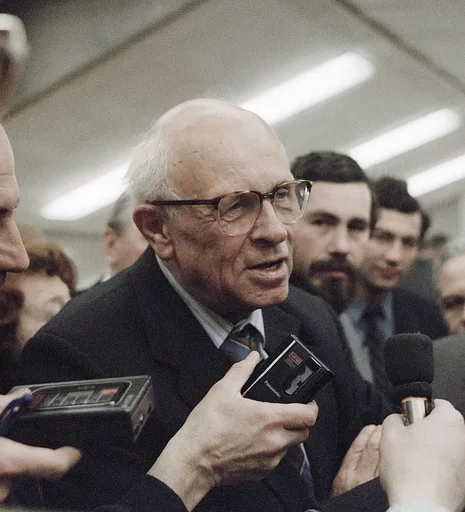
Andrei Dmitrievich Sakharov was born in , the son of a physics teacher. In 1938, he entered Moscow State University. When the university was evacuated during World War II, he attended and went on to graduate from university in Aşgabat (now Turkmenistan). After graduating, he was assigned laboratory work in Ulyanovsk. In 1943, he married Klavdia Alekseyevna Vikhireva, with whom he raised three children until her death in 1969. In 1945, the family returned to Moscow and Sakharov began to study at the Theoretical Department of FIAN (the Physical Institute of the Soviet Academy of Sciences). He researched cosmic rays, and received his Ph.D. in 1947.
In 1948, Sakharov participated in the Soviet atomic bomb project. The first Soviet atomic device was tested in 1949. After moving to Sarov in 1950, Sakharov played a key role in the next stage, the development of the hydrogen bomb. The first Soviet fusion device was tested in 1953, the same year Sakharov received his D.Sc. degree, was elected a full member of the Soviet Academy of Sciences, and was awarded a Hero of Socialist Labor titles. He continued to work at Sarov, playing a key role in the development of the first megaton-range Soviet hydrogen bomb, which was tested in 1955. He became troubled by the moral and political implications of his work, and began to campaign against nuclear weapons. He played a role in the 1963 Partial Test Ban Treaty, which was signed in Moscow.
After 1965, Sakharov returned to theoretical science and began working on particle physics and cosmology. In 1967, he wrote to the Kremlin and urged leaders to "take the Americans at their word" and accept their proposal for a ban on missile defense. In 1972, he married fellow human rights activist Yelena Bonner. In 1975 he was awarded the Nobel Peace Prize, although he was not allowed to travel to Norway to accept it.
In 1980, he was arrested for public protests against the Soviet Invasion of Afghanistan and sentenced to exile in the city of Gorky. In 1986, he was released and allowed to return to Moscow. In 1989, he was elected to the new parliament and co-led the opposition party.
Personal Name
Andrei Sakharov
Awards
Stalin Prize, Nobel Peace Prize, Order of Lenin, Hero of Socialist Labour, Fritt Ord Award, Hero of Socialist Labour, Hero of Socialist Labour, Humanist of the Year, Elliott Cresson Medal, Akademiepenning, Heinz R. Pagels Human Rights of Scientists Award, Lenin Prize, Prix mondial Cino Del Duca, Medal "For the Development of Virgin Lands", Medal "Veteran of Labour", Medal "For Valiant Labour in the Great Patriotic War 1941–1945", Dr. Tomalla Prize, Leo Szilard Lectureship Award, Albert Einstein Peace Prize, honorary doctor of the Ohio State University, Honorary doctor of the University of Groningen, honorary doctor of the Hebrew University of Jerusalem, Fellow of the American Physical Society, Jubilee Medal "In Commemoration of the 100th Anniversary of the Birth of Vladimir Ilyich Lenin", Jubilee Medal "Thirty Years of Victory in the Great Patriotic War 1941–1945", Jubilee Medal "Forty Years of Victory in the Great Patriotic War 1941–1945", Medal "In Commemoration of the 800th Anniversary of Moscow", Grand Cross of the Order of the Cross of Vytis, doctor honoris causa of Keiō University, Honorary doctor of the University of Ottawa, honorary doctorate of the Vrije Universiteit Brussel, State Stalin Prize, 1st degree, Order of the Cross of Vytis, honorary doctorate of Claude Bernard University Lyon 1, Badge of honor «For services to the Crimean Tatar people»
Languages
Russian
Positions
- people's deputy of union of socialist soviet republics
Relationships
Written By (Incoming)
Thoughts on progress, peaceful coexistence and intellectual freedom.Sakharov speaksSobranie sochineniĭ. Dnevniki. Roman-dokument, TT. 1-3Alarm and hopeMirkuvannia pro progress myrne spivisnuvannia ta intellektual'nu svoboSakharov speaksProgress, coexistence, and intellectual freedomVospominanii͡a︡Memoirs"--Po voprosu imei︠u︡shchemy bolʹshoe znachenie."Trevoga i nadezhdaDnevnikiMoscow and beyondSakharov speaksMy country and the worldO strane i mireMy country and the worldGor'kii, Moskva, dalee vezde[O strane i mireMoscow & BeyondSakharov speaksVospominanii︠a︡, 1921 -1971Moscow and beyond, 1986-1989Nauchnye trudyAndreĭ SakharovProgress, coexistence, and intellectual freedomVospominani︠i︡aMy country and the worldTrevoga i nadezhdaMemoirsRazmyshlenii︠a︡ o progresse, mirnom sosushchestvovanii i intellektualʹnoĭ svobode / A.D. Sakharov ; Pisʹmo v T︠S︡K KPSS L.I. Brezhnevu, v Sovet ministrov SSSR A.N. Kosyginu, v Prezidium Verkhovnogo Soveta SSSR N.V. Podgornomu / A.D. Sakharov, V.F. Turchin i R.A. Medvedev.Progress, coexistence and intellectual freedomMoscow & BeyondPrisiminimaiZa i protivUn an de lutteRazmyshleniya o progresse, mirnom sosushchestvovanii i intellektual'nom svobodeVospominanii͡a︡Progress, coexistence, and intellectual freedomTrevoga i nadezhdaFrom Gorky to Moscow and BeyondProgress, coexistence, and intellectual freedomA. Sakharov v bor'be za mirProgress, Coexistence, and Intellectual FreedomCollected scientific worksMoscow and beyondMemoirsWie ich mir die Zukunft vorstelleMy country and the worldO strane i mireLa liberté intellectuelle en U.R.S.S. et la coexistenceMir, progress, prava chelovekaAndrei Sakharov: Vospominaniia: V Dvukh Tomakh[Memoirs: In two volumes: ]Vospominanii͡a︡