
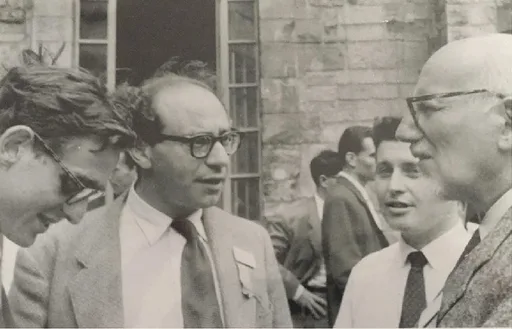
Details
Category
Author
Role
Author / Writer
Industry
Arts & Literature
Wikidata
Q364650
Notable for
John Lighton Synge FRSC FRS was an Irish mathematician and theoretical physicist whose long career included significant periods in Ireland,
Birth Date
1897-03-23
Death Date
1995-03-30
Gender
male
Nationality
Ireland
Birthplace
Dublin
Occupations
mathematician, physicist, university teacher, writer
Education
Trinity College, Dublin
Bio
John Lighton Synge FRSC FRS was an Irish mathematician and theoretical physicist whose long career included significant periods in Ireland, Canada, and the USA. He was a prolific author and influential mentor, and is credited with the introduction of a new geometrical approach to the theory of relativity. During his long scientific career, Synge published over 200 papers and 11 books. He proved the result now known as Synge's theorem, which concerns the topology of closed orientable Riemannian manifold of positive sectional curvature.
Synge was born in Dublin, Ireland, into a prominent Church of Ireland family (his uncle, John Millington Synge, was a famous playwright). He attended St. Andrew's College, Dublin, and in 1915 entered Trinity College Dublin (TCD). In 1919 he was awarded a B.A. in Mathematics and Experimental Physics. In 1922 he was awarded an M.A., and in 1926 a Sc.D. Synge was appointed to the position of lecturer at Trinity College, and then accepted a position at the University of Toronto, Canada, in 1920. From 1920-1925, Synge was an Assistant Professor of Mathematics at the University of Toronto.
Synge returned to Trinity College Dublin, in 1925, where he was elected to a fellowship and was appointed the University Professor of Natural Philosophy (the old name for physics). He went back to Toronto in 1930, where he was appointed Professor of Applied Mathematics and became Head of the Department of Applied Mathematics. He spent some of 1939 at Princeton University, and in 1941, he was a visiting professor at Brown University. In 1943 he was appointed as Chairman of the Mathematics Department of Ohio State University. Three years later he became Head of the Mathematics Department of the Carnegie Institute of Technology in Pittsburgh, Pennsylvania, where John Nash was one of his students. He spent a short time as a ballistic mathematician in the US Air Force between 1944 and 1945. He returned to Ireland in 1948, accepting the position of Senior Professor in the School of Theoretical Physics at the Dublin Institute for Advanced Studies. He retired in 1972.
Source: [Wikipedia](https://en.wikipedia.org/wiki/John_Lighton_Synge)
Personal Name
J. L. Synge
Awards
Fellow of the Royal Society, Henry Marshall Tory Medal, Fellow of the Royal Society of Canada
Languages
English
Positions
- chairperson (1961–1964)
Relationships
Written By (Incoming)
Parallel propagation of a vector around an infinitesimal circuit in an affine-connected manifold.Tensor calculus, by J.L. Synge and A. Schild.Clasical dynamicsOn the disturbance of the steady flow of an inviscid liquid between parallel planes.Mathematical Papers of Sir William Rowan HamiltonHamilton's method in geometrical optics.Relativistic hydrodynamics.ScienceGeometrical optics in moving dispersive media.Science: sense and nonsenseTalking about relativityRelativityNormals and curvatures of a curve in the Riemannian manifold.An absolute optical instrument.Collision problems and the conservation laws.RelativityOn the stability of a viscous liquid between rotating coaxial cylinders.Relativity: the general theoryTensor calculusSciencePrinciples of mechanicsPrinciples of mechanicsPrinciples of mechanicsPrinciples of mechanicsGeodesics in non-holonomic geometry.Angular momentum, mass-center and the inverse square law in special relativity.Principles of mechanicsThe equilibrium of a tooth with a general conical root.The stability of heterogeneous liquids.The theory of an incompressible periodontal membraneA characteristic junction in Riemannian spaceTensor calculusOn the deviation of geodesics and nullgeodesicsTensor calculusA criticism of the method of expansion in powers of the gravitational constant in general relativity.Obituary notice of John Charles Fields, 1863-1932.ScienceRelativityHypercircle in Mathematical Physics; a Method for the Approximate Solution of Boundary Value ProblemsPrinciples of mechanicsgeneralisation of the Riemannian line-element.Geometrical opticsOn the concept of gravitational force and Gauss's theorem in general relativity.RelativityMathematical investigation of the thrust experienced by a cylinder in a current, the motion being periodic.The displacement or deviation of circles in Riemannian space.Thermostatic control.Tensorial methods in dynamicsRelativityRelativityGeometrical opticsHydrodynamical stability.Geometrical opticsPrinciples of mechanicsPrinciples of mechanicsElementary notions of space and time.Applications of the absolute differential calculus to the theory of elasticity.Some intrinsic and derived vectors in a Kawaguchi space.The energy tensor of a continuous medium.The Petrov classification of gravitational Fields.On the connectivity of spaces of positive curvature.RelativityRelativityTensor calculusKandelman's KrimRelativityGeometrical mechanics and de Broglie waves (Cambridge monographs on mechanics and applied mathematics)On the electromagnetic two-body problem.The motion of a satellite about a heavy nucleus in the special theory of relativity.Geometrical opticsThe stability of plane Poiseuille motion.Hamilton's method in geometrical optics.Geometrical OpticsMathematical Expositions, No. 5Hypercircle in Mathematical Physics; a Method for the Approximate Solution of Boundary Value ProblemsPrinciples of Mechanics.Conditions satisfied by the vorticity and the stream-function in a viscous liquid moving in two dimensions between fixed parallel planes.Geometrical mechanics and de Broglie wavesRelativityTensor calculus, by J.L. Synge and A. Schild.Geometrical mechanics and de Broglie waves.Principal directions in an affine-connected manifold of two dimensions.Mechanical models of spaces with positive-definite line-element.Tensor calculus3e Principles of Mechanics--Ise